
The short answer
LOD 300 generally supports accurate design representation and documentation. LOD 350 adds the interfaces needed to coordinate an element with adjacent or dependent systems. LOD 400 develops information for fabrication, assembly or installation within a defined approval process.
Important: LOD is not a universal measure of model quality. Define it by model element and intended use, then state the required geometry, information and deliverables.
Buyer comparison
| Question | LOD 300 | LOD 350 | LOD 400 |
|---|---|---|---|
| Primary focus | Accurate design geometry and location | Coordination interfaces and connections | Fabrication, assembly or installation information |
| Common use | Design documents, quantity basis, model coordination | Multidisciplinary coordination and construction interfaces | Shop drawings, tickets and fabrication-oriented outputs |
| Key question | Is the element represented accurately enough for its design use? | Are the interfaces with surrounding systems represented? | Does the defined element contain the detail needed for the agreed downstream output? |
| Typical risk | Assuming every component is construction-resolved | Confusing coordination detail with fabrication responsibility | Developing detail without a clear approval or design-responsibility route |
What changes at LOD 350?
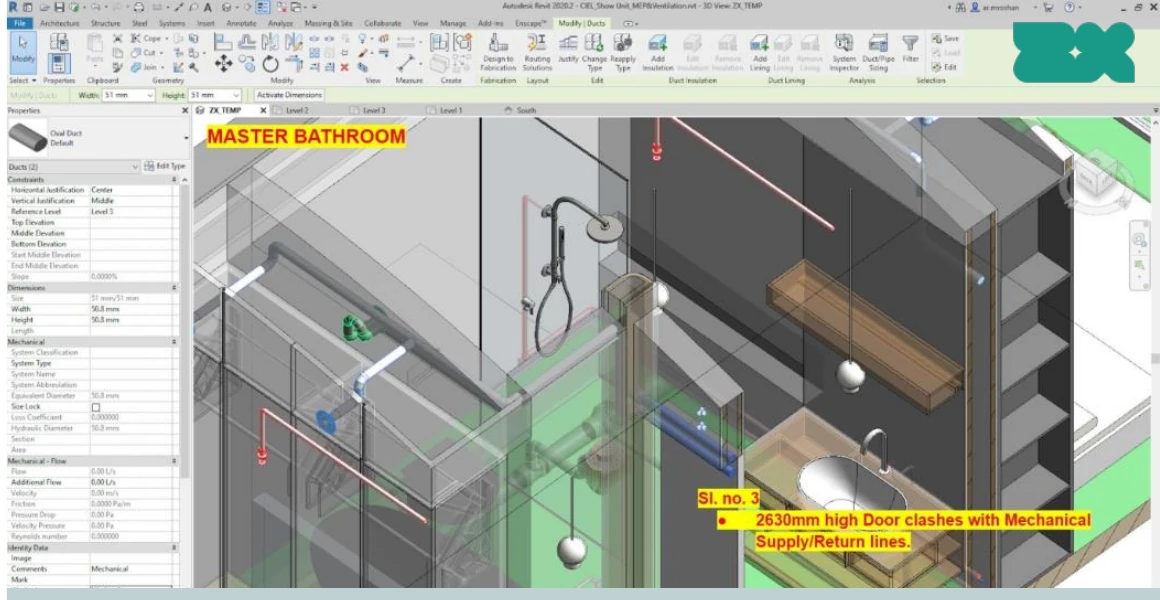
The meaningful change is not “more detail everywhere.” It is the addition of interfaces required to coordinate an element with other systems. Those interfaces may include supports, clearances, connections, penetrations, access zones or other project-specific conditions.
A useful LOD 350 scope therefore defines the disciplines being coordinated, the model inputs, the rules or tolerances being checked, who owns design decisions, and how approved resolutions return to the model.
What changes at LOD 400?
LOD 400 is commonly associated with fabrication and assembly information, but it does not remove the need to define responsibility. The modeler, specialist contractor, fabricator, designer and approving party may each own different decisions.
Before production begins, specify the shop drawings, tickets, schedules, CNC-oriented information or other outputs required. Also define review status, fabrication approval, change control and what happens when design information is incomplete.
LOD does not transfer professional responsibility
A model can be developed to an agreed level without making the production team the designer of record or approving fabricator. Contracts, responsibility matrices and the BIM execution plan should make those boundaries explicit.
ZX Collabs describes historical work in terms of its documented contribution—model development, coordination, RFIs, shop drawings, tickets and quantities—rather than implying a broader role.
Questions to put in the scope
- Which model elements require which level, and for what intended use?
- What source information is approved for production?
- Which geometry and non-geometric information must be present?
- Which adjacent systems and interfaces must be modeled?
- Which drawings, schedules, reports or fabrication-oriented outputs are required?
- Who makes design decisions and approves changes?
- What software, version, coordinates, naming and exchange formats apply?
- What are the review milestones, issue dates and revision assumptions?
A better starting sentence
Instead of writing “We need an LOD 400 model,” try: “We need the listed model elements developed for the attached shop-drawing and quantity outputs, coordinated against the approved architectural, structural and MEP inputs, in Revit [version], under the attached review and approval matrix.”
That sentence gives the delivery team something testable.